


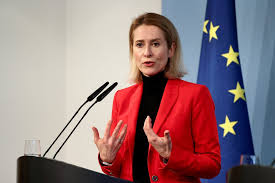
European Union foreign policy chief Kaja Kallas has indicated that EU member states are unlikely to reach agreement on a new package of sanctions against Russia at Monday’s meeting of foreign ministers in Brussels, highlighting persistent divisions within the bloc as it seeks to maintain pressure on Moscow over its war in Ukraine.
The proposed measures would form part of the EU’s 20th round of sanctions since Russia launched its full scale invasion of Ukraine in February 2022. The package is designed to tighten restrictions on Russian financial institutions, expand trade limitations, and further target entities believed to be supporting Moscow’s military and industrial capacity. However, unanimous approval is required for EU foreign policy decisions, and at least one member state has signaled it is not prepared to give its consent under current conditions.
The principal obstacle stems from Hungary’s position regarding energy security concerns. Budapest has objected to moving forward with the sanctions package while a separate dispute remains unresolved over Russian oil deliveries through the Druzhba pipeline. Hungary and Slovakia have argued that interruptions to oil transit have serious economic implications, and Hungarian officials have made clear that their support for new sanctions is contingent upon satisfactory assurances related to energy supply continuity.
The impasse illustrates the delicate balancing act facing the European Union. On one hand, the bloc has sought to project unity and resolve in response to Russia’s actions, progressively expanding sanctions to include banking, technology exports, energy revenues, and individuals linked to the Kremlin. On the other hand, internal differences persist among member states with varying degrees of economic exposure to Russia, particularly in the energy sector.
Several EU capitals have expressed frustration over the delay. German officials, among others, have urged Hungary to reconsider its stance, arguing that a failure to adopt new sanctions ahead of the anniversary of the invasion would weaken Europe’s collective message of solidarity with Ukraine. Diplomats suggest that negotiations are continuing behind closed doors, with efforts focused on finding technical or political compromises that could unlock consensus.
Since 2022, the EU has imposed sweeping restrictions aimed at curbing Russia’s ability to finance its war effort. These have included asset freezes, travel bans, restrictions on Russian banks’ access to the SWIFT system, oil price caps, and export controls on advanced technologies. While the sanctions have had measurable economic effects on Russia, they have also prompted adaptation strategies by Moscow, including redirecting trade flows toward Asia and strengthening alternative financial arrangements.
The latest disagreement underscores a broader challenge for the EU: maintaining cohesion among 27 member states with diverse economic interests while sustaining long term pressure on Russia. Analysts note that sanctions fatigue, domestic political considerations, and energy market volatility have made consensus more complex over time.
Despite the setback, EU officials insist that discussions remain active and that the bloc’s strategic objective has not changed. Kallas emphasized that work continues toward securing agreement, signaling that while a decision may not be reached immediately, diplomatic engagement is ongoing. The outcome will be closely watched as a test of the EU’s unity and its capacity to sustain coordinated action in the face of protracted geopolitical conflict.









Leave a comment