


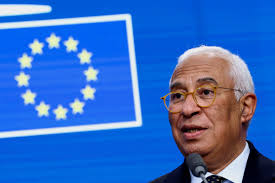
European Union leaders gathered at a historic Belgian castle for a strategic “retreat” aimed at confronting a pressing question facing the bloc’s future. How can Europe remain competitive in a world increasingly dominated by the economic and technological power of the United States and China. The informal summit reflects growing concerns among policymakers that Europe’s economic performance, innovation capacity, and geopolitical influence are lagging behind major global rivals at a time of rising trade tensions, technological competition, and shifting alliances.
The meeting, hosted by European Council President Antonio Costa at the 16th century Alden Biesen castle, brought together heads of government and senior EU officials for candid discussions about the bloc’s economic direction. Leaders sought to evaluate Europe’s current challenges and brainstorm new strategies to strengthen growth, improve productivity, and secure the continent’s position in an increasingly competitive global landscape.
At the heart of the discussions is a recognition that the European Union has struggled to keep pace with the United States and China over the past two decades. Economic growth in Europe has consistently trailed that of both powers, while productivity gains and technological innovation, especially in critical fields such as artificial intelligence, have not matched the scale achieved by global competitors. Policymakers fear that unless decisive reforms are implemented, Europe risks falling further behind in the industries that will define the future global economy.
Another driving force behind the retreat is the changing geopolitical environment. European leaders are grappling with the impact of trade disputes with Washington, export restrictions from Beijing on vital raw materials, and the broader uncertainty caused by a shifting international order. These pressures are forcing the bloc to rethink its economic model, diversify supply chains, and reduce dependencies that could leave European industries vulnerable to external shocks or political leverage.
Central to the agenda is the future of the EU’s single market, which many analysts believe holds untapped potential to drive growth if fully integrated. Former Italian prime ministers Mario Draghi and Enrico Letta, who authored influential reports on European competitiveness and market integration, were invited to present their recommendations. Their proposals include completing the single market by 2028, deepening capital markets, and simplifying regulations that businesses say hinder innovation and expansion across borders.
Regulatory reform and bureaucratic simplification are also major topics. European Commission President Ursula von der Leyen has repeatedly warned that fragmented financial systems and complex rules make it harder for European companies to scale up and compete globally. Leaders are examining ways to streamline laws, reduce administrative burdens, and create an environment that encourages entrepreneurship, research, and investment.
Trade diversification is another pillar of the discussions. The EU is exploring how to expand partnerships with countries outside traditional markets to reduce dependence on both the United States and China. At the same time, policymakers are considering policies that support European industries in strategic sectors such as clean energy, semiconductors, artificial intelligence, and defense, all seen as crucial to long term competitiveness and economic resilience.
Despite shared concerns about competitiveness, significant divisions remain among member states regarding how to move forward. Some leaders advocate deregulation and deeper trade agreements, while others favor more protective measures such as “Buy European” policies that prioritize locally produced goods and strengthen domestic industries. Debates over common borrowing, defense spending, and industrial policy illustrate the complex balancing act between maintaining open markets and building strategic autonomy.
Industry leaders have added urgency to the discussions, with hundreds of companies calling for bold reforms to address high energy costs, fragmented markets, and investment gaps. Business groups argue that without decisive action, Europe could lose ground in the global race for innovation and economic leadership. Experts, however, stress that Europe still possesses significant strengths, including skilled talent, capital resources, and strong startup ecosystems, which could help it remain competitive if reforms are implemented effectively.
The castle retreat is expected to shape decisions at a formal EU summit scheduled for March, where leaders may commit to concrete timelines and policy changes. As geopolitical tensions rise and economic competition intensifies, the outcome of these discussions could determine whether Europe emerges as a stronger, more unified global power or continues to struggle against faster growing rivals.










Leave a comment