


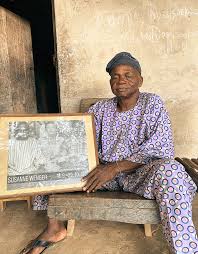
Nigeria has bid farewell to one of its most revered traditional artists with the burial of master wood carver Kasali Akangbe Ogun, who died last week after a brief illness. His passing marks the end of an era for Yoruba sacred art and cultural preservation, leaving behind a legacy deeply rooted in spirituality, heritage, and global artistic influence.
Kasali Akangbe Ogun was born into a distinguished lineage of Yoruba wood carvers in Osogbo, a city long celebrated as a cradle of artistic and spiritual expression in south western Nigeria. From an early age, he was immersed in the techniques, symbols, and philosophies of traditional carving, inheriting not just a craft but a calling. Over decades, he transformed this inherited knowledge into a distinctive artistic voice that carried Yoruba cosmology far beyond its place of origin.
Renowned for a unique style marked by lean, elongated faces and dynamic, flowing forms, Akangbe Ogun’s work was immediately recognisable. Nigerian art patron Olufemi Akinsanya described his carvings as possessing a rare visual rhythm, where wood seemed to bend and breathe with spiritual life. His sculptures were not merely decorative objects but embodiments of belief, ritual, and ancestral presence, reflecting the intimate relationship between art and worship in Yoruba culture.
Central to his life’s work was his involvement in the New Sacred Art Movement, a transformative artistic and spiritual initiative founded in the 1960s by the late Austrian Nigerian artist and Yoruba priestess Susanne Wenger. The movement emerged at a critical moment when the Osun Sacred Grove and its surrounding forest were under severe threat from deforestation and neglect. Through large scale sculptures, shrines, and ritual art, the movement sought to revive sacred traditions while physically marking and protecting the forest landscape.
Kasali Akangbe Ogun became one of the leading figures of this movement, contributing monumental carvings that now stand within the Osun Forest. His works are inseparable from the grove itself, rising among ancient trees and along winding paths as visual expressions of devotion to Osun, the Yoruba goddess of fertility and water. For him, art was both spiritual duty and environmental stewardship, a belief he articulated clearly during a visit in 2020 when he said that heritage must not be left naked and that the planting of trees was essential to preserving sacred space.
The Osun Sacred Grove, located on the outskirts of Osogbo, was recognised by Unesco as a World Heritage Site in 2005. The designation acknowledged its immense cultural significance within Yoruba cosmology and its status as the largest protected high primary forest in the region. The grove is revered as the abode of Osun and is dotted with sanctuaries, shrines, sculptures, and artworks dedicated to Osun and other Yoruba deities. It has come to symbolise Yoruba identity itself, widely regarded as the last surviving sacred grove of its kind in Yoruba culture.
Akangbe Ogun’s carvings within the grove form part of this living heritage. They are not static museum pieces but active participants in ritual life, seasonal festivals, and communal memory. His work helped ensure that spiritual practices remained visible and relevant in a rapidly changing society, bridging the gap between ancestral belief systems and contemporary artistic expression.
Internationally, his influence continues to grow. Works from the New Sacred Art Movement, including those associated with his legacy, are currently featured in the landmark Nigerian Modernism exhibition at Tate Modern. This global recognition places Akangbe Ogun within a broader narrative of modern African art, highlighting how indigenous spiritual traditions have shaped and enriched modernist expression rather than standing apart from it.
Exhibition curator Osei Bonsu described Kasali Akangbe Ogun as a vital figure whose work brought profound spiritual depth to Yoruba devotional practice. He noted that Akangbe Ogun’s art stands as a testament to a life devoted to faith, community, and visual poetry. These qualities define an artist who saw no separation between belief, environment, and creativity.
As he is laid to rest, Kasali Akangbe Ogun leaves behind more than carved wood. He leaves a philosophy of cultural responsibility, reminding future generations that art can be a tool for preservation, resistance, and renewal. In an age where traditional knowledge faces erosion, his life’s work stands as enduring proof that heritage, when nurtured with devotion and integrity, can speak powerfully to the world while remaining firmly rooted in its origins.








Leave a comment