


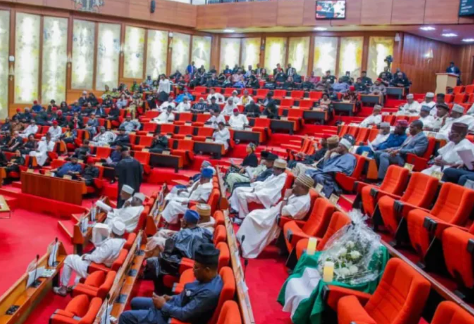
The Nigerian Senate has approved President Bola Ahmed Tinubu’s request to borrow N1.15 trillion from the domestic debt market to help finance the deficit in the 2025 Appropriation Act.
The approval followed the presentation and adoption of a report by the Senate Committee on Local and Foreign Debts, presented by its Vice Chairman, Senator Manu Haruna, during Wednesday’s plenary session.
Senator Haruna explained that the 2025 Appropriation Act, pegged at N59.99 trillion, reflected a N5.25 trillion increase from the N54.74 trillion initially proposed by the executive arm of government. This adjustment widened the budget deficit to N14.10 trillion, while the initially approved borrowing provision of N12.95 trillion created an unfunded gap of N1.147 trillion.
To close this gap, the Senate agreed to raise the domestic borrowing limit in the 2025 budget by N1.147 trillion, ensuring that government operations and capital projects remain adequately funded.
Following the approval, the Senate directed the Federal Ministry of Finance and the Debt Management Office (DMO) to ensure that the borrowing is undertaken strictly within approved fiscal parameters, with terms that are favourable, transparent, and sustainable.
Lawmakers also mandated the Committee on Local and Foreign Debt to monitor the implementation and utilisation of the borrowing and to receive quarterly reports from the Ministry of Finance and the DMO on the loan’s status, utilisation, and repayment plans. The Senate further tasked the Appropriation Committee with ensuring that the funds are used exclusively to finance the deficit in the 2025 budget.
President Tinubu, in his earlier letter to the National Assembly dated November 4, said the borrowing would support his administration’s fiscal strategy aimed at stimulating economic growth, enhancing infrastructure investment, and strengthening social welfare programmes across the country.
The approval underscores the Tinubu administration’s commitment to maintaining fiscal stability while driving national development under the Renewed Hope Agenda.













Leave a comment