


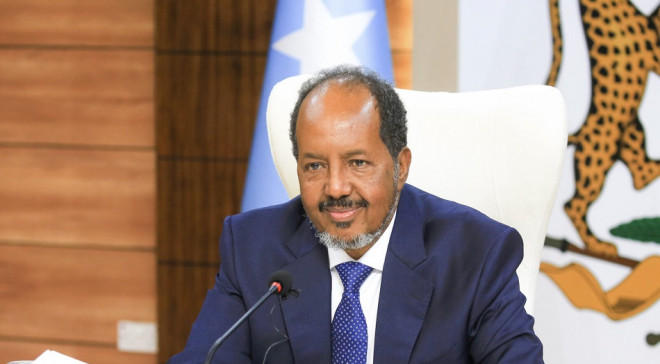
Somalia’s President Hassan Sheikh Mohamud has disclosed that he has survived at least five assassination attempts by the Islamist militant group al-Shabab in the past two years, underscoring the ongoing threats facing the country’s leadership and fragile security environment. In an interview with the BBC’s Paul Njie, the president revealed that the most recent attempt on his life took place in March, describing himself as a prime target of the al-Qaeda-affiliated group that has waged a relentless insurgency in Somalia for more than a decade.
Despite the repeated attempts to eliminate him, President Mohamud insisted that al-Shabab’s influence and capabilities are weakening under his administration. He emphasized that his government’s intensified counter-terrorism operations, combined with international support, have significantly eroded the group’s power structure and ability to destabilize Somalia. His remarks sought to reassure both Somalis and the international community that, even though the threat remains severe, progress is being made in the fight against extremist violence.
However, independent analysts and regional security experts have pointed to al-Shabab’s recent territorial gains as evidence that the group continues to pose a formidable challenge. In some rural areas, the militants have managed to regroup, exert control, and launch attacks against military positions, raising concerns that the insurgency still has the capacity to destabilize not only Somalia but also the wider Horn of Africa. The persistence of these attacks highlights the complex battle between government forces and insurgents, where progress is often met with setbacks.
President Mohamud, who came to power in 2022 on a promise to restore stability, has made defeating al-Shabab one of his top priorities. His government has launched coordinated offensives with the support of local communities, African Union forces, and international partners. He acknowledged, however, that the fight is not just military but also ideological, requiring long-term strategies to counter extremist propaganda, strengthen governance, and address the socioeconomic conditions that militants often exploit to recruit vulnerable youth.
In addition to security threats, questions have arisen over potential regional rivalries spilling into Somalia. Reports of possible tensions between Egyptian and Ethiopian peacekeepers stationed in the country have sparked fears that Somalia could become an arena for wider geopolitical disputes. President Mohamud firmly dismissed these concerns, declaring that Somalia would not allow itself to be dragged into regional conflicts. He stressed that his government is committed to ensuring that foreign peacekeepers operate strictly within the framework of stabilizing Somalia, rather than advancing the interests of their home countries.
His reassurances are aimed at calming public anxiety and demonstrating that Somalia’s sovereignty will be protected even as the nation continues to rely on international support to fight extremism. For a country that has endured decades of civil war, political instability, and extremist violence, the president’s survival from multiple assassination attempts stands as both a stark reminder of the risks facing Somali leaders and a testament to the resilience of the government in the face of existential threats.
As Somalia continues its long and difficult journey toward stability, President Hassan Sheikh Mohamud’s revelations highlight both the gravity of the challenges ahead and the determination of his administration to press forward. Whether the government can sustain its momentum against al-Shabab, rebuild institutions, and prevent Somalia from becoming entangled in regional rivalries will determine the country’s future security and prosperity.












Leave a comment