


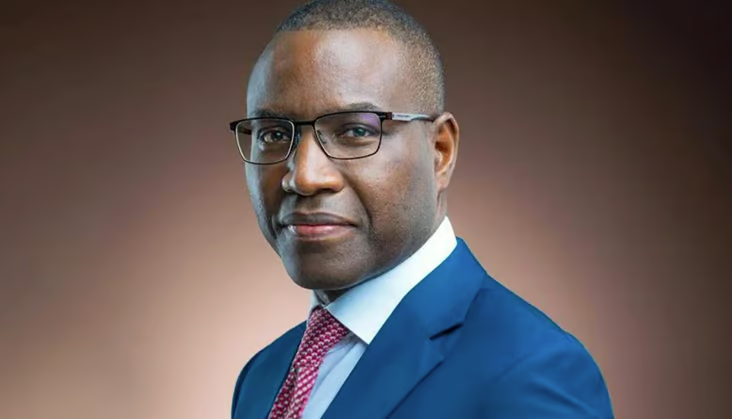
Amadou Hott, the former Minister of Economy, Planning, and Cooperation of Senegal, is emerging as a bold voice for change in Africa’s economic landscape. As he positions himself as a candidate for the presidency of the African Development Bank (AfDB), Hott is calling for a radical shift in the way African nations and institutions finance their development. His message is clear: Africa must stop depending on public money and international handouts and start tapping into private capital markets to fund its future.
In his vision for the AfDB, Hott emphasizes economic self-reliance and sustainable financing strategies. He believes that the time has come for the continent to move beyond the aid-driven models of the past and adopt market-driven solutions that empower African nations to fund their growth. According to Hott, the traditional reliance on multilateral donors and concessional loans has limited the continent’s potential, creating a cycle of dependency that stifles innovation and weakens sovereignty.
A central pillar of Hott’s campaign is to reposition the AfDB as a catalyst for private sector investment rather than a perpetual aid dispenser. He argues that the Bank must play a more active role in creating environments where businesses can thrive, markets can expand, and investments can flow without excessive reliance on public funds. By de-risking projects, providing blended financing solutions, and helping governments design investor-friendly policies, the AfDB can become a bridge between African economies and global capital markets.
“We need to shift our mindset,” Hott insists. “Africa is rich in resources, talent, and opportunity. But to unlock this potential, we must mobilize private capital and build financial ecosystems that are attractive to investors.”
Hott also calls for a tougher stance in negotiations with multilateral financial institutions. He believes African countries should have a stronger voice and more negotiating power when engaging with international lenders and donors. In his view, these relationships have too often been unequal, with African interests sidelined in favor of externally imposed conditions and priorities.
While his bold rhetoric and reformist agenda have gained him support from several quarters, Hott has also faced criticism from those who see his vision as overly ambitious or detached from the political and economic realities of the continent. Some critics argue that Africa still needs concessional financing to address deep-rooted challenges in healthcare, education, infrastructure, and poverty reduction. Others caution that relying too heavily on private markets could expose vulnerable economies to greater risk, especially in times of global financial instability.
Hott acknowledges these concerns but remains resolute. “This is not about abandoning aid,” he clarifies. “It’s about using it more strategically as a lever, not a crutch. We must use public funds to crowd in private investments, not to replace them.”
He points to successful models across the continent where strategic partnerships with the private sector have transformed energy, agriculture, and fintech industries. By scaling such efforts and institutionalizing innovation within the AfDB, Hott believes the continent can move toward a future of financial autonomy and inclusive growth.
As the race for the AfDB presidency draws near, Amadou Hott’s candidacy symbolizes a pivotal moment for Africa. It raises fundamental questions about how the continent should fund its development, who gets to decide its priorities, and how to balance ambition with pragmatism. If elected, Hott’s leadership could mark a new chapter for the Bank, one where Africa reclaims its economic narrative and charts a course grounded in resilience, entrepreneurship, and self-determination.
Ultimately, Hott’s vision is not just about the African Development Bank; it’s about changing how Africa sees itself and how the world engages with Africa, not as a continent of problems to be solved, but as a dynamic partner with solutions and potential waiting to be unleashed.




Leave a comment