


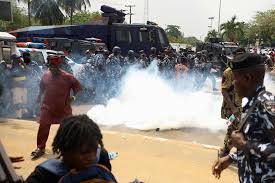
Nigerian police fired tear gas on Wednesday to disperse angry residents protesting demolition work in Makoko, one of Africa’s largest floating slums, after thousands of people were displaced from their homes in Lagos. Witnesses said at least one protester was injured as security forces moved in to break up the demonstration.
Makoko, a densely populated informal settlement built largely on stilts above the Lagos Lagoon, has long been home to fishing communities and low income families. Residents say the demolitions began without adequate notice or consultation, leaving many families suddenly homeless and forcing them to seek shelter with relatives or sleep outdoors.
Lagos state authorities, backed by armed police and heavy equipment, have defended the operation, arguing that the affected structures were built illegally and posed a serious safety risk. Officials said many of the wooden homes were constructed dangerously close to high voltage power lines, creating the potential for fatal accidents and large scale fires.
Protesters, however, accused the government of using safety concerns as a pretext for forced evictions. Chanting slogans and holding placards, residents demanded an immediate halt to the demolitions, compensation for lost property, and a clear resettlement plan. Community leaders said the operation has destroyed livelihoods, particularly for fishermen who rely on direct access to the water.
Human rights groups and urban development advocates have also criticized the demolitions, warning that the use of force against vulnerable communities could escalate tensions. They argue that while safety and urban planning are legitimate concerns, authorities should prioritize dialogue, relocation support, and humane alternatives rather than sudden evictions.
Makoko has for years symbolized the stark inequalities in Lagos, Africa’s most populous city, where luxury developments exist alongside sprawling informal settlements. As demolitions continue, the clash highlights the broader challenge facing Nigerian authorities as they balance urban development, public safety, and the rights of marginalized communities.










Leave a comment