


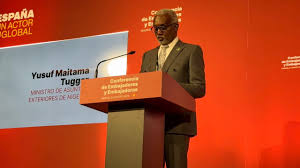
Nigeria’s Minister of Foreign Affairs, Ambassador Yusuf Maitama Tuggar, has called on Europe and Africa to resist isolationist tendencies and instead deepen cooperation rooted in shared history, geography, and mutual responsibility. He made the appeal while delivering a keynote address at the 2026 Annual Conference of Spanish Ambassadors in Madrid, attended by 182 serving Spanish envoys.
Speaking on the theme Good Neighbourliness Building Bridges or Building Walls, Ambassador Tuggar described Europe and Africa not as distant continents but as parts of a single geopolitical space, separated more by perception than reality. He emphasised that the Mediterranean has historically functioned as a bridge linking peoples, economies, and cultures, rather than as a dividing line.
The Foreign Minister highlighted Africa’s longstanding contribution to the global economy, recalling the trans Saharan gold trade of the fourteenth century and early Atlantic commerce in commodities such as sugar and palm oil. He argued that contemporary Europe Africa relations must be understood within this shared historical context, and proposed that Africa be recognised alongside Europe and Ibero America as an integral part of Spain’s wider historical identity.
On migration, Ambassador Tuggar acknowledged its political sensitivity but cautioned against policies shaped by fear instead of realism. While reaffirming Nigeria’s opposition to irregular migration, he warned that the securitisation of labour mobility and the weaponisation of anti migrant sentiment have destabilised parts of the Sahel. He pointed to Spain’s circular migration arrangements with African countries as a practical and humane model, consistent with long established seasonal labour patterns in West Africa.
He further explained that externally driven policies which criminalised migration in transit countries undermined local economies, empowered trafficking networks, and contributed to insecurity and political breakdown. Such measures, he argued, neither reduced migration flows nor enhanced regional stability.
Highlighting bilateral cooperation, Ambassador Tuggar praised Nigeria Spain collaboration on migration management, police training, and efforts to combat human trafficking and smuggling. He described Spain as offering a constructive model for Europe through dialogue based engagement and Africa focused development partnerships.
On development and trade, the Foreign Minister warned that Africa’s marginal share of global trade remains incompatible with its population size. He noted that dependence on raw material exports in exchange for manufactured goods perpetuates underdevelopment and creates economic pressures that ultimately transcend borders. Investment in value addition and development finance, he said, should be viewed as investments in shared stability rather than acts of charity.
Ambassador Tuggar also addressed the shrinking space for diplomacy amid rising militarisation and polarised domestic politics worldwide. He urged diplomats to show greater resolve in defending dialogue, compromise, and long term thinking against simplistic security narratives.
Touching on democratic challenges in West Africa, he outlined Nigeria’s leadership in launching a Regional Partnership for Democracy with the United Nations Development Programme. The initiative, he explained, is premised on the understanding that democratic systems must reflect local histories, cultures, and developmental realities to be sustainable.
In his closing remarks, the Nigerian Foreign Minister called on Spain’s diplomatic corps to act as advocates of good neighbourliness, both within Europe and globally. At a time when many nations are tempted by walls and withdrawal, he argued that genuine statesmanship lies in building bridges that history, geography, and shared interests already demand.











Leave a comment