


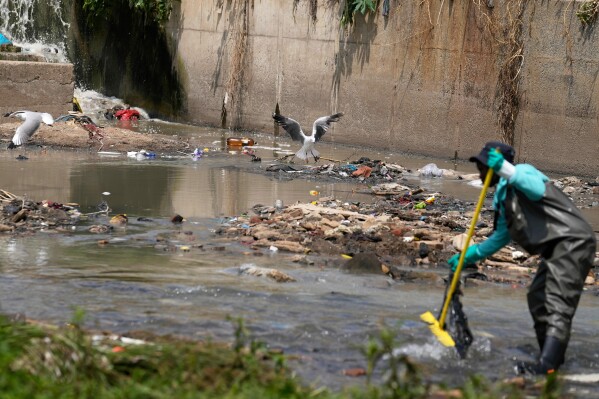
In Johannesburg’s oldest township, volunteers in wetsuits wade through thigh-deep water in the polluted Jukskei River to repair a net designed to trap garbage but damaged by heavy rains. Without the net, the low-lying shacks of Alexandra, home to over half a million residents, could face catastrophic flooding.
The timing is significant. This weekend, world leaders from the Group of Twenty rich and developing nations will meet in Johannesburg for the bloc’s first summit in Africa. South Africa, the host, plans to spotlight issues affecting poor countries, including the increasing frequency and severity of natural disasters fueled by climate change. The country will call on wealthy nations and international financial institutions to provide more support, echoing pleas made at recent global climate talks in Brazil.
Alexandra’s proximity to Sandton, South Africa’s wealthiest financial district, underscores stark contrasts. Flooding often submerges bridges, leaving children unable to reach school. “It is a big hazard,” said Semadi Manganye, a resident and co-founder of the volunteer group Alexandra Water Warriors. Their work illustrates the daily challenges that climate-exacerbated disasters pose to vulnerable communities.
“The ravages of the climate are directly linked to the ravages of inequality,” said Binaifer Nowrojee, president of the Open Society Foundations. “Countries are facing the destructive choice between growing their economies and taking climate action.”
The World Bank reports that the poorest nations experienced nearly eight times as many natural disasters between 2010 and 2020 compared with the decade from 1980 to 1990. Southern Africa has faced particularly destructive weather events in recent years. Cyclone Idai, intensified by climate change, devastated Mozambique, Malawi, and Zimbabwe in 2019, killing thousands and causing an estimated $2 billion in damages, according to the World Bank. For comparison, Malawi’s GDP is just $12 billion.
Last year, El Nino caused one of the worst droughts in decades in the region, severely affecting small-scale agriculture and worsening poverty. For Alexandra and similar communities, these disasters are not abstract statistics but immediate threats to life, education, and livelihoods.
As the G20 summit convenes in Johannesburg, South Africa aims to press global leaders to address the disproportionate burden climate disasters place on poorer countries, stressing the urgent need for investment, technology transfer, and policy support to protect vulnerable populations.






Leave a comment