


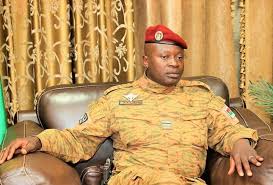
Togo has arrested and expelled Burkina Faso’s former president Paul Henri Damiba, returning him to his home country after authorities in Ouagadougou accused him of attempting to destabilise the current military government. The move underscores the fragile political environment across parts of West Africa, where coups, counter coups, and allegations of plot attempts have become an increasingly common feature of governance.
According to sources, Damiba was detained by Togolese authorities before being expelled and handed over to officials from Burkina Faso. The arrest followed accusations from the Burkinabe government that the former leader was involved in efforts to undermine the administration of Captain Ibrahim Traore, who seized power in 2022 and remains head of the military led government. While detailed evidence has not been made public, the accusations were serious enough to prompt swift regional action.
Paul Henri Damiba rose to prominence in January 2022 when he led a military coup that overthrew Burkina Faso’s elected civilian government. At the time, the takeover was justified by widespread public frustration with the government’s inability to contain escalating attacks by Islamist militant groups linked to al Qaeda and Islamic State. Large parts of Burkina Faso had fallen under militant control, with thousands killed and millions displaced, creating a national security emergency.
However, Damiba’s tenure proved short lived. Despite promises to restore security and stabilise the country, violence continued to spread. His perceived failure to deliver results, combined with growing discontent within the armed forces, led to his removal later in 2022. He was ousted in a second coup led by Ibrahim Traore, then a junior army officer, who accused Damiba of betraying the goals of the revolution and losing focus on the fight against militant groups.
Since his removal, Damiba had reportedly been living outside Burkina Faso. His presence in Togo placed him within a region where political tensions remain high and borders are increasingly sensitive due to fears of cross border interference and coup plotting. The decision by Togolese authorities to arrest and expel him signals a willingness among some West African states to cooperate closely with military governments and prevent their territories from being used as bases for political destabilisation.
The current leadership in Burkina Faso has taken a hard line against perceived threats, both internal and external. Traore’s government has accused former officials, political opponents, and external actors of attempting to undermine its rule. Supporters argue that such measures are necessary to protect national security during a time of war against militant groups. Critics, however, warn that accusations of coup plotting can be used to silence dissent and consolidate power.
Burkina Faso is part of a wider belt of instability across the Sahel, where military takeovers have occurred in recent years in Mali, Guinea, and Niger. These countries have increasingly distanced themselves from Western partners and sought new alliances, while emphasising sovereignty and security over democratic timelines. The repeated cycle of coups has raised concerns among regional bodies and international observers about the erosion of constitutional order.
Damiba’s expulsion adds another chapter to Burkina Faso’s turbulent recent history and highlights how former leaders can remain focal points of political tension long after leaving office. Whether the allegations against him will lead to formal charges or further action remains unclear. What is evident, however, is that the struggle for power and stability in Burkina Faso is far from over.
As the region continues to grapple with insecurity, economic hardship, and political uncertainty, events like these reflect deeper structural challenges facing West African states. The arrest and expulsion of a former head of state illustrates how fragile trust has become, not only within countries but also across borders, as governments seek to secure their hold on power in an increasingly volatile environmen












Leave a comment