


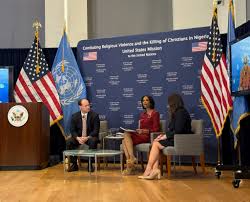
The United States has announced new visa restrictions targeting Nigerians it believes are responsible for acts of what it describes as anti Christian violence. The decision marks one of Washington’s strongest public interventions in Nigeria’s internal security and religious tensions in recent years.
Secretary of State Marco Rubio said on Wednesday that the United States is taking firm action in response to the mass killings and violence affecting Christian communities in parts of the country. He emphasized that the restrictions will apply not only to those directly involved but also to their immediate family members. Rubio specifically mentioned radical Islamic terrorists, Fulani ethnic militias, and other violent actors operating within Nigeria and in neighboring regions.
According to Rubio, this policy will also extend to individuals and governments elsewhere in the world that Washington believes are involved in violations of religious freedom. He stressed that protecting religious minorities is a central part of US foreign policy.
The announcement follows weeks of rising tension between Washington and Abuja after President Donald Trump threatened possible military action against Nigeria, claiming Christians in the country face persecution from radical Islamist elements. Trump subsequently designated Nigeria as a Country of Particular Concern.
Nigeria’s government has repeatedly rejected these claims, arguing that violence in the country is not religiously motivated but driven by criminality, land disputes, illegal mining, and competition over scarce resources. Officials also point out that extremist groups such as Boko Haram have killed more Muslims than Christians over the past decade.
Nigeria, a nation of roughly 220 million people, is almost evenly divided between Christians and Muslims and is home to more than 200 ethnic groups. Its security challenges are deep rooted and complex. The country continues to face threats from Boko Haram and the Islamic State West Africa Province in the northeast, banditry and mass abductions in the northwest, and deadly clashes between farmers and pastoralists in the central region.
In recent years, armed gangs have expanded their operations, especially in central Nigeria, where kidnappings for ransom have surged. The combination of violent extremism, criminality, and ethnic tensions has overwhelmed local security structures and contributed to widespread instability.
As the United States enforces its new visa restrictions, analysts say the move could strain diplomatic relations but also intensify pressure on Nigeria to address long standing security issues. Abuja has not yet issued an official response to the latest announcement, but government officials in the past have insisted that foreign governments must avoid framing Nigeria’s complex conflicts solely as religious crises.
The coming weeks will show whether this policy shift leads to deeper engagement, diplomatic tension, or renewed efforts to tackle insecurity across Africa’s most populous nation.






Leave a comment